What Documents You Need for a Horse Insurance Claim
When you have to file a mortality or major-medical claim on a horse, the paperwork you kept beforehand decides how it goes. Here's the documentation insurers typically ask for — and how to have it ready before you need it.
By Brian Bickell, who builds HorseBook from a ranch in Oklahoma — usually from whatever the folks using it tell me is missing.
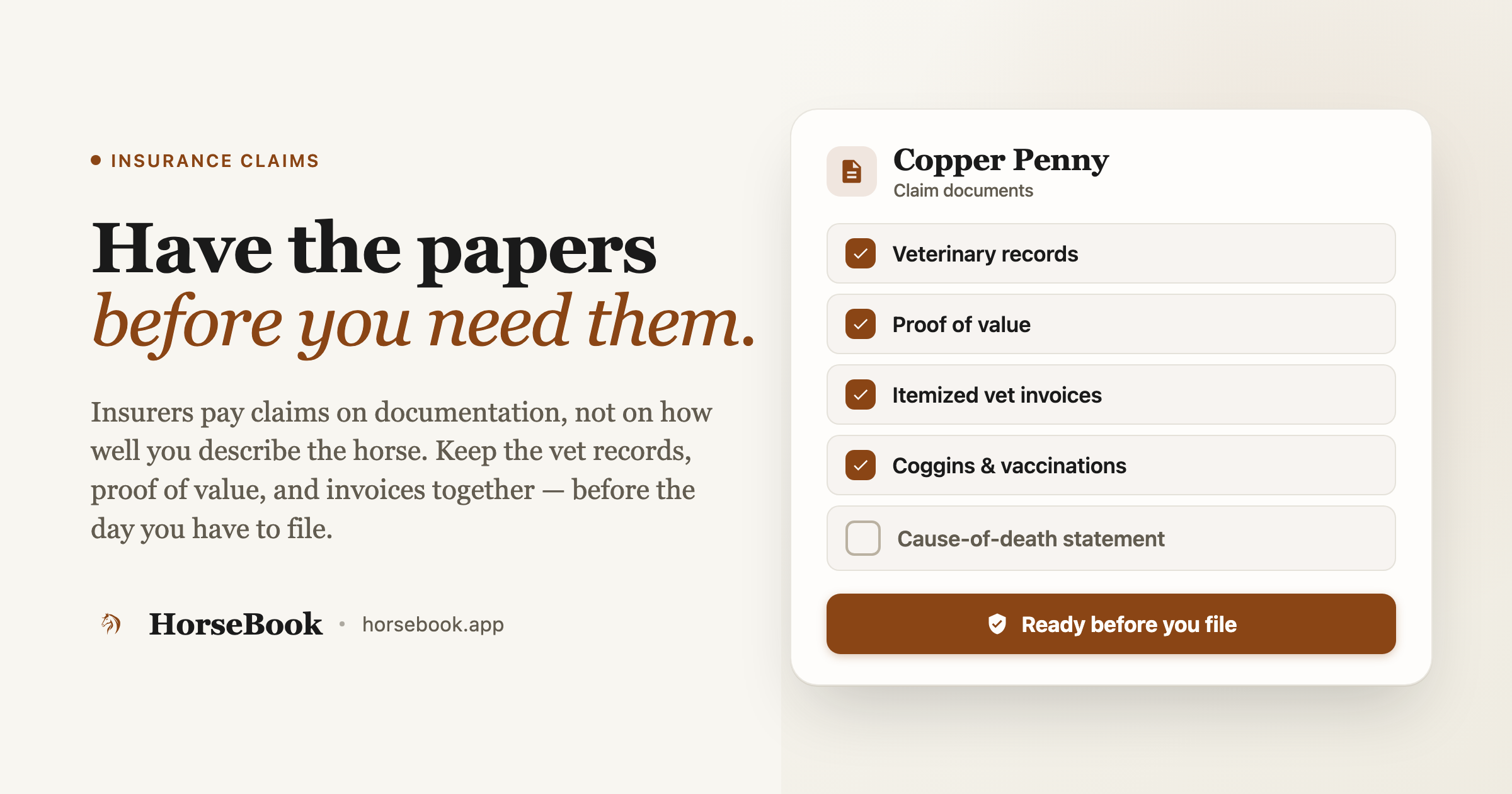
Nobody buys horse insurance hoping to use it, and nobody wants to think about a claim. But if the day comes — a colic surgery, an injury, or worse — the paperwork you kept before anything happened is what decides how the claim goes. Insurers pay claims on documentation, not on how well you describe the horse over the phone. The good news is that the documents they ask for are mostly things you should be keeping anyway. The trick is having them together and current when you need them, instead of scrambling to reconstruct a health history during the worst week of your year.
Here's what a horse insurance claim generally needs, and how to have it ready.
Educational, not legal, financial, or insurance advice. Every policy is different, and the policy language governs. Read your own policy's requirements, and when a claim comes up, call your insurer or agent first — they tell you exactly what they need.
First rule: notify your insurer promptly
Before the document list, the thing that trips up more claims than anything: most policies require you to notify the insurer promptly when a covered horse gets seriously ill, is injured, dies, or needs major treatment. Some major-medical policies want notice before certain non-emergency procedures. In a real emergency you treat the horse first — but call the insurer (or your agent) as soon as you reasonably can. Waiting can complicate or reduce a claim.
Know your policy's notice window before you're standing in a stall at 2 a.m. It's in the policy. Read it once now so it's not a surprise later.
The documents a claim typically needs
Requirements vary by insurer and by the type of claim, but most claims draw on the same core set:
For a major medical or surgical claim
- Itemized veterinary invoices for the treatment — line items, not just a total. This is the heart of a medical claim.
- Veterinary records describing the diagnosis, treatment, and the horse's relevant history.
- The claim form from your insurer, completed.
- Sometimes a veterinarian's statement connecting the treatment to the covered condition.
For a mortality claim
- A veterinarian's statement of the cause of death, and in many cases a necropsy (post-mortem) report — insurers frequently require one, especially for sudden or unexplained deaths.
- Proof of value — usually established when the policy was written, supported by purchase records.
- The claim form and often notice given before euthanasia except in true emergencies (many mortality policies require the insurer be consulted before a horse is put down on economic grounds).
Underneath both: the horse's history
Whatever the claim, insurers want to see that the horse had a documented health history — vaccinations, Coggins, routine and prior vet care. A clean, continuous record supports the claim. Gaps and missing history invite questions and delay. This is the part you can't create after the fact, which is exactly why it matters to keep it continuously.
Proving what the horse was worth
For a mortality claim, the payout is tied to the horse's insured value — and that's usually settled when you buy the policy, not after a loss. But you support that value with records: the bill of sale or purchase records, and depending on the horse, registration papers (the same proof of ownership an inspector checks at a brand inspection if you haul through the western states), show or performance records, breeding records, or a prior appraisal. Keeping those together means the value side of a claim is a matter of pulling a folder, not rebuilding a case. Our buying and selling paperwork guide covers the purchase records that anchor this.
How to have it all ready before you need it
The cruel thing about claim documentation is that you assemble it during a crisis — a sick or dying horse — which is the worst possible time to be hunting through a glovebox and a text-message thread for a Coggins date. The fix is to keep the records continuously and in one place, so a claim packet is something you pull, not something you build.
That's what HorseBook is for:
- Scan every vet invoice and record as it comes in. Snap a photo and it's filed with the horse — so when the insurer wants itemized invoices and a treatment history, they're already there, dated and in order, not scattered across a year of emails.
- Track expenses alongside the medical records. Vet bills, medication costs, and the running total live with the horse. For a medical claim, that itemized cost trail is exactly what's being reimbursed.
- Keep the value-supporting papers with the horse too — bill of sale, registration, breeding and show history — so proof of value is one place, not five.
- Print a clean report when you file. HorseBook can export a per-horse report — you pick the sections (medical, expenses, and the rest) and it comes out as one organized PDF. When an adjuster asks for the horse's history, you hand them a tidy document instead of a shoebox.
None of this changes what your policy covers. What it changes is how fast and how cleanly you can substantiate a claim — and whether you spend the worst week of the year fighting your filing system on top of everything else.
The bottom line
A horse insurance claim runs on documentation you mostly should already have:
- Notify the insurer promptly — know your policy's window before you need it.
- For a medical claim: itemized vet invoices plus the treatment records.
- For a mortality claim: a veterinarian's cause-of-death statement, often a necropsy, and proof of value.
- Underneath both: a continuous, documented health history the insurer can trust.
Keep those records as they happen, in one backed-up place, and a claim becomes a matter of pulling and printing — not reconstructing your horse's life story during a crisis. And always follow your own policy's requirements; the insurer and your agent are the authority on what your specific claim needs.
Try it
HorseBook runs on the iPhone app and the web app, with a 14-day free trial and no credit card. If your horse is insured, spend a few minutes getting its vet records and invoices scanned in now, while nothing's wrong — it's the version of this you'll be glad you did.
And if there's something about keeping claim-ready records that HorseBook doesn't do yet, tell me. I read every message, and a lot of what's in the app started as one.
Frequently asked questions
What documents do I need to file a horse insurance claim?
Insurers typically ask for the horse's veterinary records, proof of value (purchase records, and for mortality claims often a vet certificate), itemized vet invoices for a medical claim, and for a mortality claim a veterinarian's statement of cause of death or a necropsy report. Notify your insurer immediately — most policies require prompt notice — and follow your specific policy's requirements, which govern.
How do I prove the value of a horse for an insurance claim?
Usually with purchase records (bill of sale), and depending on the horse, things like show or breeding records, registration papers, and prior appraisals. Mortality policies often set the insured value at the time you take out the policy, so the value question is largely settled up front — keeping the supporting records makes it easy to substantiate.
Do I need to call my insurer before the vet treats my horse?
For anything major, often yes. Many major-medical policies require you to notify the insurer promptly and, in some cases, before certain elective procedures. In a genuine emergency you treat the horse first, but call the insurer as soon as you reasonably can. Read your policy's notice requirements before you're in the middle of one.
What is a mortality claim versus a major medical claim?
A mortality claim is filed when an insured horse dies (or is euthanized on veterinary advice) and pays out the insured value; it typically needs a cause-of-death statement or necropsy. A major medical or surgical claim reimburses veterinary costs for illness or injury up to policy limits and needs itemized vet invoices and records. Coverage terms vary by policy.
How far back do insurers want veterinary records?
It varies, but insurers commonly want a picture of the horse's health history, so keeping consistent records — vaccinations, Coggins, vet visits, and any prior conditions — helps. Gaps or missing history can slow a claim. This is one reason to keep records continuously rather than reconstructing them after something goes wrong.