Horse Brand Inspection Paperwork, State by State (2026 Guide)
Which states require a horse brand inspection, when you need one, what it costs, and the lifetime travel permit that saves you from doing it over and over. A plain-English, state-by-state guide for western horse owners and haulers.
By Brian Bickell, who raises paint and quarter horses at Bickell Ranches in Stillwater, Oklahoma.
The first time somebody told me I'd need a "brand inspection" to move a horse, I figured it didn't apply to me — my horses aren't even branded. Turns out that's not what it checks. In a good chunk of the western United States, a brand inspection is how the state confirms you actually own the horse you're hauling, branded or not, and getting caught without one at a checkpoint or a sale barn can hold your trailer up and cost you a fine.
If you live in the West, or you're hauling through it, this is one of those pieces of paperwork nobody warns you about until you're standing at a port of entry. So here's the guide I wish I'd had — which states require it, when, what it runs, and the one permit that keeps you from doing it over and over.
Educational, not legal or regulatory advice. Brand laws, fees, and permit rules are set by each state's livestock board and change without much notice. Always confirm with the destination state's brand board or livestock commission before you load up.
In This Guide
- What a Brand Inspection Actually Is
- When You Need One
- The Smart Move: A Lifetime Travel Permit
- The Brand-Inspection States, One by One
- Quick Reference Table
- States That Exempt Horses
- Keeping the Paper Where You Can Find It
- Common Questions
What a Brand Inspection Actually Is
A brand inspection is an official verification of ownership. A state-licensed brand inspector looks the horse over — brands, if it has any, plus markings, color, and description — and cross-references that against your ownership paperwork (registration papers, bill of sale, a prior brand certificate). If everything lines up, they issue a certificate that says, in effect, "this person is in lawful possession of this horse."
This is one more reason your registration papers earn their keep — they're part of how an inspector confirms you own the horse. If yours have gone missing, it's worth sorting out before a trip; here's how to replace lost registration papers.
The whole system exists for one reason: livestock is portable and valuable, and brand law is how the western states have fought theft and straying for well over a century. That's also why the inspection isn't optional in these states — it's not a service you buy when you feel like it, it's a document the law expects you to have at certain moments.
The key thing to understand: it is not just a check for a brand. An unbranded horse in a brand-inspection state still gets inspected. The inspector is verifying ownership, and the brand (when there is one) is just one piece of evidence.
When You Need One
Every state draws the lines a little differently, but the common triggers are:
- Change of ownership — buying or selling a horse. This is the most universal one.
- Crossing a county line (in a few states, like Montana) or a state line (many).
- Selling through a livestock auction or sale barn — the market requires it before the horse changes hands.
- Slaughter — a licensed establishment requires an inspection first.
Some states require inspection for all of these. Others only care about change of ownership and let you travel freely once you own the horse. And at least one — Washington — wants an inspection essentially any time a horse leaves the state, travel or sale. The only way to know your situation is to check the specific state, which is what the sections below are for.
This ties directly into hauling across state lines. A brand inspection is one of the up-to-five documents you may need for interstate travel, alongside your health certificate and Coggins — I laid out that whole picture in the interstate horse transport documents guide, and this post is the deep dive on the brand-inspection piece of it.
The Smart Move: A Lifetime Travel Permit
Here's the single most useful thing in this whole guide, and most horse owners don't know it exists.
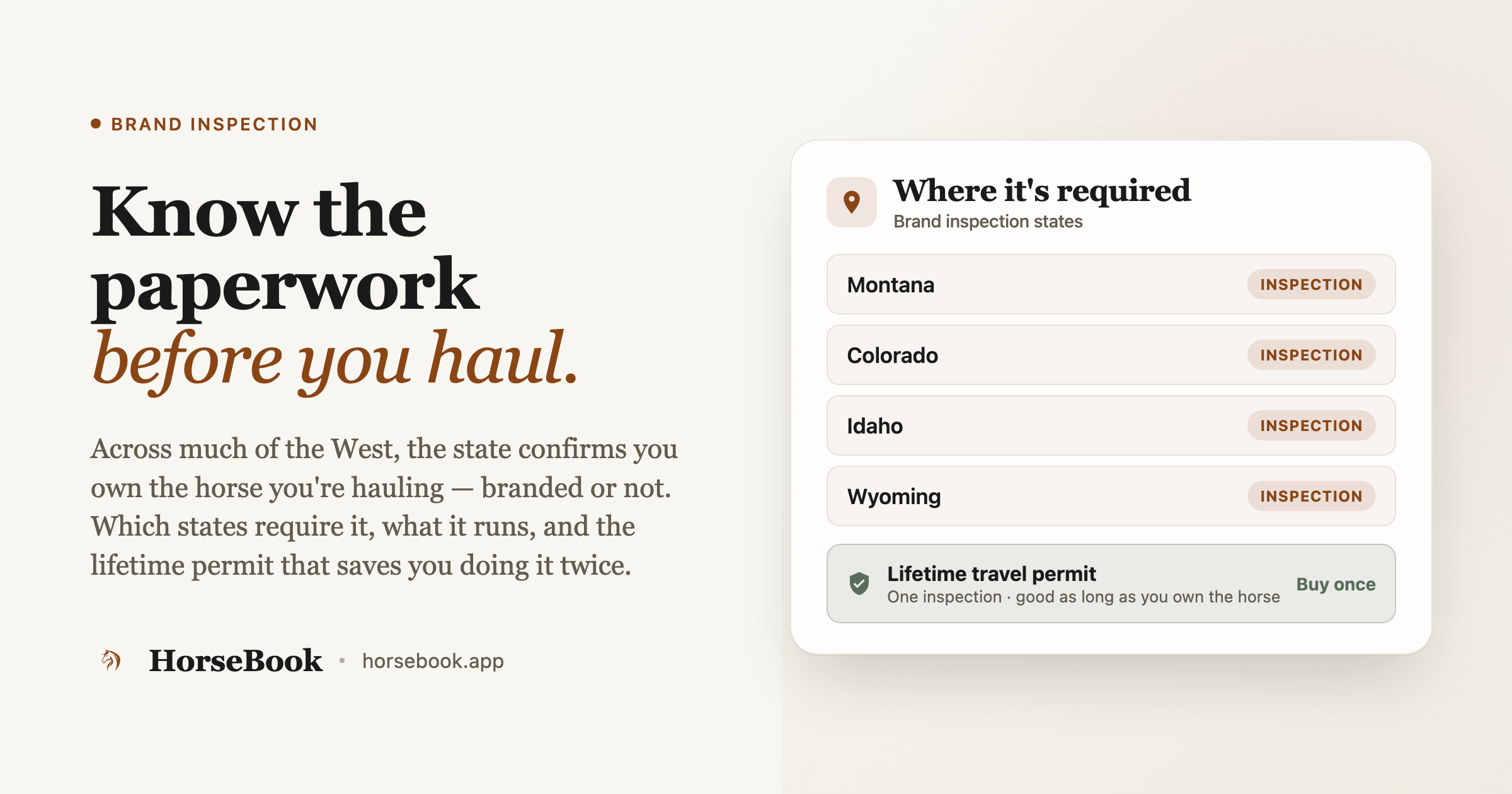
Several brand states sell a lifetime or permanent travel permit for the horse. You pay once, the inspector verifies the horse one time, and that document stays with the horse for the rest of its life — as long as ownership doesn't change. No more getting a fresh inspection every time you cross a line to a show or a trail ride.
- Colorado calls it a Permanent Travel Permit (folks also call it a lifetime horse permit). It runs about $40, one time, good for the life of the horse under the same owner.
- New Mexico issues a Permanent Equine Transportation Permit (Form 1-H) that's good for the length of your ownership.
- Idaho issues a Lifetime certificate for horses, mules, and asses that can be used for nationwide travel.
And it gets better: several states honor each other's permits through reciprocity. South Dakota, for example, recognizes a lifetime travel permit from any U.S. brand state or Canadian province — carry that permit and you can move through without buying another inspection. (Not every pair of states reciprocates — Idaho, notably, doesn't have reciprocal agreements with Wyoming or Montana — so confirm your specific route.)
If you haul the same horse across the same lines year after year, the lifetime permit is almost always the cheapest paperwork you'll ever own. Buy it once, scan it, and stop thinking about it.
The Brand-Inspection States, One by One
These are the states where brand inspection genuinely applies to horses. Details and fees change — the numbers below are current-as-of-writing and directional — so use them to know what questions to ask, then confirm with the state.
Colorado
Brand inspection is mandatory on horses, mules, and donkeys in Colorado — for change of ownership, for transport across county or state lines, and for sale. The inspection fee for horses not going through a licensed market is a minimum fee per owner plus a small per-head charge (recently $35 minimum plus $2 per head; Colorado raised its brand fees in late 2025, so verify the current schedule). The standout option is the $40 Permanent Travel Permit described above. Colorado runs an active brand program and inspections are widely available. Confirm current rules with the Colorado Department of Agriculture Brand Inspection Division.
Montana
Montana is one of the stricter states. Brand inspection is required before crossing a county line, before a change of ownership, before sale at a livestock auction, and before slaughter. If your horse doesn't already have a Montana state brand ID on file, plan ahead — schedule the inspection at least a month before you travel so the mailed documentation reaches you in time. Montana also operates highway checkpoints. Confirm with the Montana Department of Livestock, Brands Enforcement Division.
Wyoming
Wyoming's brand program covers equines. For horses moving interstate to a Board-approved out-of-state livestock market, Wyoming charges a per-head fee (recently $1 per head for that specific movement). Wyoming operates ports of entry and checkpoints where papers get verified. Confirm current requirements and fees with the Wyoming Livestock Board.
Idaho
Idaho requires brand inspection for horses and offers a useful menu: annual or seasonal certificates for owners who travel in and out of the state, and a Lifetime certificate for horses, mules, and asses that's good for nationwide travel and for sale, trade, or slaughter. If the inspector comes to your place, Idaho charges a $45 Equine Farm Service Fee per visit. To move someone else's livestock within Idaho you need a written permit from the owner (free from the State Brand Inspector's office). Idaho does not have reciprocal agreements with Wyoming or Montana, so don't assume a neighboring state's permit covers you. Confirm with Idaho State Police, Brand Inspection.
New Mexico
New Mexico requires either a one-way Form 1 inspection or a Permanent Equine Transportation Permit (Form 1-H) when you move a horse out of your livestock district. Crossing the New Mexico state line also requires a CVI and a negative Coggins on top of the brand paperwork. The permanent permit is good for the length of your ownership. Confirm with the New Mexico Livestock Board.
Washington
Washington's rule is simple and broad: all equine leaving Washington State must be accompanied by a brand inspection. The only exception is a horse headed directly to a public livestock market in another state where Washington brand inspectors are stationed (the Lewiston Livestock Market in Idaho and the Northwest Livestock Commission in Hermiston, Oregon). If you're moving a horse out of Washington for any other reason — a show, a sale, a move — you need the inspection. Confirm with the Washington State Department of Agriculture.
Utah, Nevada, and the Dakotas
Utah, Nevada, North Dakota, and South Dakota all require brand inspection for horses, generally for change of ownership and movement, with fees typically in the $10–$50 per-head range plus any travel charge. South Dakota is worth calling out for its reciprocity: it honors a lifetime travel permit from any U.S. brand state or Canadian province, so a permit you already hold may already cover you there. Confirm specifics with each state's brand board or livestock commission.
Oregon
Oregon is a partial case — brand inspection is required for certain movements and transactions rather than across the board. If you're buying, selling, or hauling out of Oregon, check whether your specific move triggers it. Confirm with the Oregon Department of Agriculture, Brand program.
Quick Reference Table
This covers the states where brand inspection applies to horses. Fees and rules change — verify with the state brand board before you travel.
| State | Applies to Horses? | Common Triggers | Notes |
|---|---|---|---|
| Colorado | Yes | Ownership change, county/state line, sale | $40 lifetime Permanent Travel Permit available |
| Montana | Yes | County line, ownership change, auction, slaughter | Allow ~1 month if no state brand ID; checkpoints active |
| Wyoming | Yes | Ownership change, interstate to markets | Ports of entry active |
| Idaho | Yes | Movement, sale, ownership change | Lifetime certificate; $45 farm-service fee; no WY/MT reciprocity |
| New Mexico | Yes | Leaving livestock district, sale | Permanent Equine Transportation Permit (Form 1-H) |
| Washington | Yes | Any horse leaving the state | Broadest rule — inspection to leave, few exceptions |
| Utah | Yes | Ownership change, movement | — |
| Nevada | Yes | Ownership change, movement | — |
| North Dakota | Yes | Ownership change, movement | — |
| South Dakota | Yes | Ownership change, movement | Honors lifetime permits from other brand states (reciprocity) |
| Oregon | Partial | Certain movements/transactions | Check whether your specific move triggers it |
States That Exempt Horses
This is where the common wisdom is often wrong, so it's worth being precise. Some states run a well-known brand program for cattle but exempt horses from it:
- California — the Bureau of Livestock Identification requires brand inspection for cattle, but a brand inspection is not required for a horse in California. (You still need a CVI, entry permit, and Coggins to bring a horse into the state — those are separate from brand law.)
- Nebraska — equines are exempt from brand inspection. Nebraska's brand-inspection area applies to cattle in the western two-thirds of the state; horses aren't part of it.
I call these out because you'll see "brand-inspection state" lists that lump California and Nebraska in with the others. For cattle that's fair. For horses, they're exempt — and it's an easy way to buy an inspection you didn't need, or to assume the rule works the same for both species when it doesn't. As always, the state livestock board is the authority if you're unsure.
Every state not named in this guide falls outside the brand-inspection system for horses entirely — the standard interstate paperwork (CVI plus Coggins) is what you'll need there. That full picture, state by state, is in the interstate transport guide.
Keeping the Paper Where You Can Find It
A brand inspection certificate isn't worth much sitting on the kitchen counter when you're two states away at a port of entry. Same lesson as every other piece of horse paperwork: the document only helps if it's with you and you can put your hands on it.
That's a big part of why we built document scanning into HorseBook. Snap a photo of your brand inspection certificate — and your lifetime travel permit, your Coggins, your health certificate — and they're filed with that horse's records on your phone. When the inspector at the checkpoint asks for papers, you pull them up in seconds instead of digging through the glovebox. A lifetime permit especially is worth scanning the day you get it: it's a document you'll want for the next fifteen years, and paper that old has a way of wandering off.
Whatever you use — binder, folder, phone — the rule holds: keep it in the truck, and keep it where you can reach it.
Common Questions
Which states require a horse brand inspection? Roughly eleven western states: Montana, Idaho, Wyoming, Colorado, New Mexico, Utah, Nevada, North Dakota, South Dakota, Washington, and Oregon (for certain movements). California and Nebraska run brand programs for cattle but exempt horses. Confirm with the state livestock board before you haul.
When do I need a horse brand inspection? The common triggers are change of ownership, crossing a county or state line, selling through a livestock auction, and slaughter. Some states inspect for all of those; others only for change of ownership. Washington requires one any time a horse leaves the state.
How much does a horse brand inspection cost? Usually $10–$50 per head, plus a farm-call or travel fee if the inspector comes to you. Colorado charges a minimum per-owner fee plus a small per-head fee; Idaho charges a $45 equine farm service fee per visit. Many states also sell a one-time lifetime permit for around $40.
What is a lifetime horse travel permit? A one-time brand-inspection document that stays with the horse for life, as long as ownership doesn't change, so you don't re-inspect every time you cross a line. Colorado, Idaho, and New Mexico offer versions, and states like South Dakota honor permits from other brand states through reciprocity.
Do I need a brand inspection if my horse has no brand? Yes — in a brand-inspection state the inspection verifies ownership, not just the presence of a brand. Unbranded horses are inspected the same way. If the horse has no state brand ID on file, allow extra lead time.
The Bottom Line
Brand inspection is one of those western-states rules that catches out-of-staters and new owners flat-footed, but the system isn't complicated once you know it:
- In brand states, a brand inspection verifies ownership — branded or not.
- The triggers are ownership change, crossing lines, auction, and slaughter — check which apply in your state.
- A lifetime travel permit (Colorado, Idaho, New Mexico, and more) pays for itself fast if you haul often.
- California and Nebraska exempt horses — don't assume their cattle rules apply to your gelding.
Buy the permit if your state sells one, keep the certificate where you can reach it, and confirm the rules with the state board before a trip. The paperwork is cheap. Getting turned around at a checkpoint with a full trailer is not.
For the rest of the travel picture, see the interstate transport documents guide, the complete Coggins guide, and — if a sale is what's prompting all this — the buying and selling paperwork guide.
Brian Bickell is the founder of HorseBook and raises paint and quarter horses at Bickell Ranches in Stillwater, Oklahoma.
Frequently asked questions
Which states require a horse brand inspection?
Brand inspection applies to horses in roughly eleven western states: Montana, Idaho, Wyoming, Colorado, New Mexico, Utah, Nevada, North Dakota, South Dakota, Washington, and Oregon (for certain movements). Note that California and Nebraska run brand programs for cattle but exempt horses. Requirements and exemptions change, so always confirm with the state livestock board before you haul.
When do I need a horse brand inspection?
It depends on the state, but the common triggers are: change of ownership (buying or selling), crossing a county or state line, selling through a livestock auction, and slaughter. Some states inspect for all of these; others only for change of ownership. A few — like Washington — require an inspection any time a horse leaves the state.
How much does a horse brand inspection cost?
Usually $10 to $50 per head, plus a farm-call or travel fee if the inspector comes to your property (Idaho, for example, charges a $45 equine farm service fee per visit). Colorado charges a minimum fee per owner plus a small per-head fee. Many states also sell a one-time lifetime or permanent travel permit for around $40 that covers the horse as long as you own it.
What is a lifetime horse travel permit?
It's a one-time brand-inspection document that stays with the horse for its whole life, as long as ownership doesn't change — so you don't have to get a fresh inspection every time you cross a line. Colorado, Idaho, New Mexico, and other brand states offer versions of it, and several states honor each other's permits through reciprocity agreements. If you travel often, it's usually the cheapest paperwork you'll ever buy.
Do I need a brand inspection if my horse has no brand?
Yes, in a brand-inspection state you can still need one even if the horse isn't branded. The inspection is a verification of ownership, not just a check for a brand — the inspector records the horse's markings and confirms you're the lawful owner. Unbranded horses in these states are inspected the same way; if the horse has no state brand ID on file, plan extra lead time.